
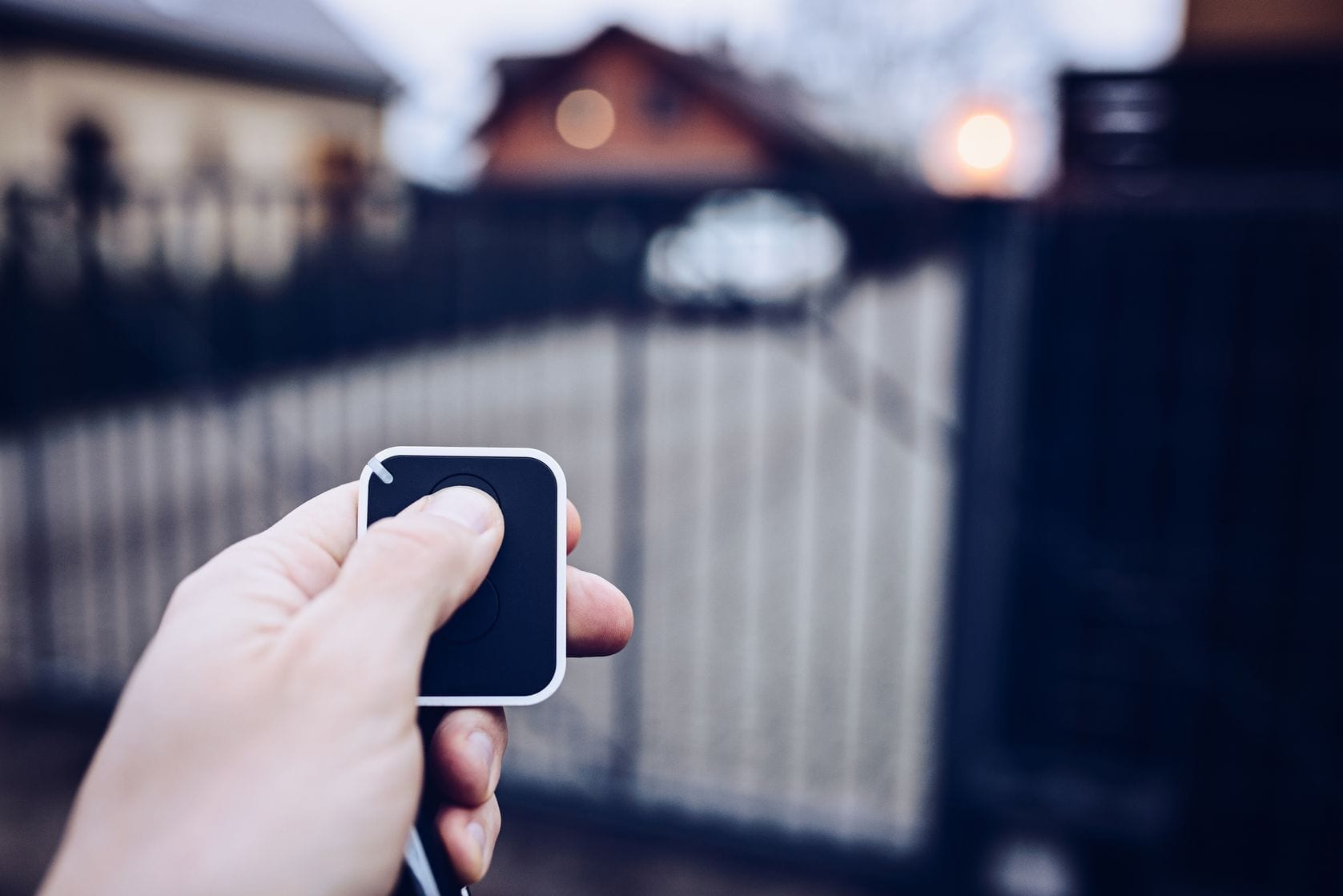
Unfortunately, it is possible for hackers to open your garage door – and very easily if you have outdated equipment.
Believe it or not, garage door openers have been around since the early part of the last century. They have, of course, improved since the earliest models were introduced, but there’s a chance that what you’re using currently could put your home security at risk.
Here’s what you need to know about garage door openers and which ones can offer the best security protection.
A Short History of Garage Door Openers
In the mid-1920s – right around the time that car ownership became common in the U.S. – the first electric garage door opener was introduced. Those early garage door openers were far from convenient.
Unlike the remote openers we’re used to today, the first systems were wired. Typically, the technology included a wired switch that ran from the door’s motor to a keypad inside the car. These systems were still in place until the mid-to-late 1940s.
New technology eventually utilized radio frequency signals to send a code from the opener to a wireless remote. But in the 1960s, thieves figured out that all of these opener systems were using the same code. They didn’t need to have the remote control for your particular garage door; they could use virtually any remote to access your garage.
The garage door industry soon improved their products to allow consumers to change the codes themselves, using a binary system of 8-12 dip switches that set each switch to either 1 or 0 (either an up or a down position).
Which Garage Door Openers Are Vulnerable to Hacking?
But there were still vulnerabilities in this new system. A 12-switch remote meant that there were 4,096 possible codes, which sounds like a lot unless you know how fast and efficiently math can work.
In 2015, a security researcher named Samy Kamkar demonstrated how easy it is for hackers to select the correct code. He programmed a child’s toy to show that it would take less than ten seconds to open a target’s garage door.
Any garage door opener that uses dip switches is vulnerable to hacking because these codes are “fixed.” There are only 4,096 combinations and the hacked toy could try every one of those codes in a period shorter than 30 minutes. But using knowledge about how openers transmit code sequences, Kamkar was eventually able to reduce the hacking time from 30 minutes to 6 minutes, and then less than ten seconds.
A hacker doesn’t need to reprogram a toy to get access to your fixed code system. They can also surreptitiously leave a code grabber near your garage door. That device records the code transmitted by radio frequencies when you open your garage door.
When the thief comes back later to retrieve the device, the recorded code allows them instant access.
How to Check to See if Your Garage Door Opener Should be Replaced
A fixed code significantly increases your chances of a serious security breach. If you open your garage door remote and see a row of up-or-down switches, you have a fixed code system and should consider upgrading to a more secure technology.
Most of the openers owned today use “rolling” codes rather than fixed codes to open or close the garage door. A rolling code changes every time the door is opened.
Unfortunately, there are also ways to exploit rolling code signals, so garage door opener manufacturers updated their systems to let the rolling codes expire more quickly, which should help to alleviate this latest vulnerability.
What to Look For in a New Garage Door Opener
Check to see if your current garage door opener offers rolling codes, hopping codes, Security+, or Security 2.0. If it’s not or you can’t tell, give Austin’s Greater Garage Doors a call. We pride ourselves on being the local experts when it comes to garage door installation or repair.
Our technicians are up to date on the latest technology such as garage door openers, garage door controls, gate openers, and door accessories.
Austin’s Greater Garage Doors is a locally-owned, family-run business and has over 15 years of experience providing quality, affordable garage doors, and garage opener solutions. Call (512) 865-4813 to make an appointment, and see how easy it is to safeguard your home against hackers and thieves.
